

Placeholder subtext about what we did and why that worked.
Equipment Inspection SEO Case Study
From 1 click in three months to a website that paid for itself in month three

CLICKS
From 1 to 108 a month

ENQUIRIES
0 to 30+ in 90 days

INDUSTRY
Equipment Inspection

REPORT DATE
September 2026
Overview
This equipment inspection company carries out the legally required thorough examinations that businesses need on their lifting equipment, machinery and other kit, under regulations like LOLER. Their customers are plant hire firms, quarries, workshops, groundwork companies, construction sites and manufacturers in South England.
Their website didn't show up for anything, on Google or in AI search. We rebuilt it from scratch, gave every page a specific search to target, built the site's authority with directory listings and links from business publications, and published articles answering the questions their buyers were already asking.
The client paid their first invoice on 11 June 2026 and the new website went live on 22 June. In the three months before launch, the old site got 1 click from Google. In August alone, the new site got 108 clicks. Form enquiries went from 0 to 13 in ten weeks, with more phone calls on top of that, and the SEO paid for itself in month three.

The peaks and troughs are natural for a B2B service - their customers search on weekdays, during work hours.
The Problem
The old website looked like a website, but as far as Google was concerned it barely existed. It had very little authority, which means hardly any other trusted websites linked to it. The pages were missing the headings Google uses to work out what a page is about, and none of them were built around the words customers actually type into Google. It was an online brochure that nobody could find.
The Director had already spent a lot of money with agencies promising to fix this, and had nothing to show for it. We hear that from a lot of business owners. By the time they speak to us, they've been burned at least once and are understandably wary of anyone selling SEO.
The business itself was a good one. Inspections cost between £100 and £300 each, which doesn't sound like much, but most customers have several pieces of equipment that need inspecting, and the vast majority stay with the Director for years. Each new customer is worth far more than their first invoice. The website just wasn't bringing any of them in.
"I've just been through it on desktop and it's day and night compared to the last website."
What We Changed
We started by rebuilding the website from scratch on Wix Studio, with every page built to target a specific search from a potential customer. The site didn't go live until the Director was completely happy with it.
Before switching over, we did two things a lot of rebuilds skip. We kept the old page addresses on the new website, so anything Google had already indexed carried straight across, however small its value. And we recorded every ranking position for the target keywords in Semrush before launch, so we could measure our impact accurately rather than guess at it.
Next, we built the site around how customers actually search. Each of the five inspection types got its own page, and each of those acts as a hub for the specific jobs that sit underneath it. Under lifting equipment, for example, there are separate pages for crane inspections, forklift inspections and several others.
That matters because most customers don't search for the name of the regulation. A plant hire firm searches "forklift inspection", not "LOLER thorough examination". The broader terms still get searched and still have their own pages, but the specific pages are the ones that bring in enquiries.
We then published articles answering the questions buyers ask right before they book, like what happens if your lifting equipment isn't compliant, and how to pass an inspection. Every article links through to the relevant regulation and job pages, which helps Google understand how the site fits together and pushes visitors towards the pages that turn into enquiries.
Alongside that, we built the site's authority. Google treats links from other trusted websites as votes of confidence, and this site had almost none. We submitted the business details to over 50 directories and have built links from several relevant business publications so far. It's the least visible part of SEO, and it's the part that moves rankings the most.
We also sorted their email. It was tied up with their old web provider, so we moved it into a Google Workspace account in the company's own name.
"First lead received. Already converted it and got the job booked in. It's only a little one but it's more than I've had come through the website in months."
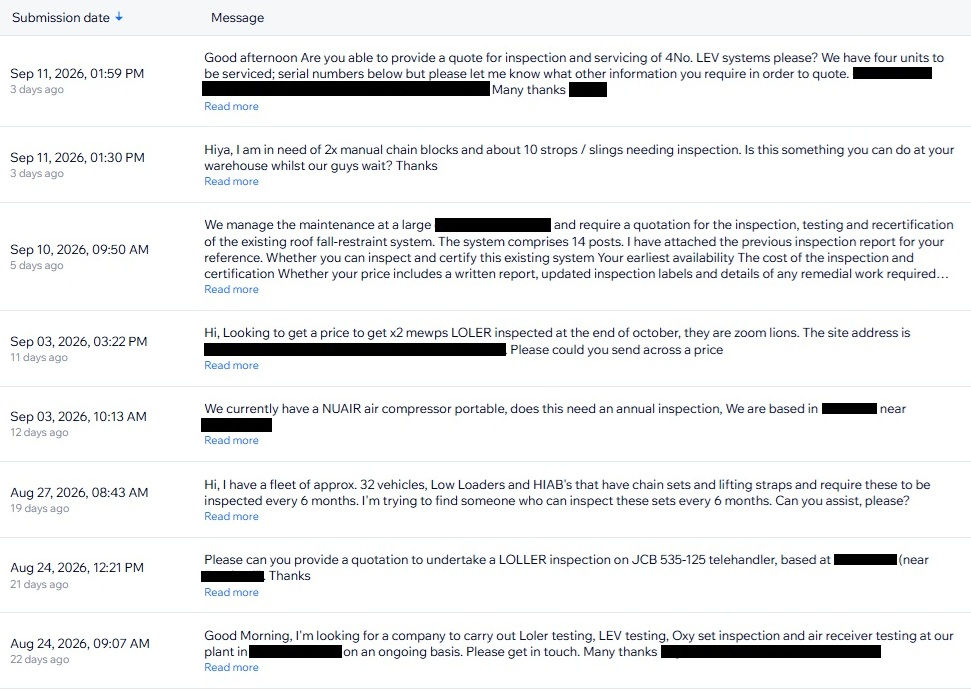
See the quality and frequency of inbound enquiries (and this company receives more by phone than by form submission).
Why This Worked
This worked because we fixed the two things actually holding the website back. Google couldn't tell what the site was about, and the site had no authority.
Structure came first. You can't expect one page to rank for every service and every way a customer might search. That's as true for a builder or an electrician as it is for an inspection company. If you do loft conversions, kitchen extensions and garage conversions, each one needs its own page, because each one is a different search. Once every page had one clear job, Google could match the right page to the right search.
Then authority. Good pages tell Google what you do. Links from other trusted websites tell Google you're worth showing. The directory listings and publication links are a big part of why the site's average position went from 77 to 15 in a matter of months. Without them, the new pages would have been well built and still stuck on page eight.
The articles played their part too. They gave Google a clearer picture of what the business specialises in, and gave AI tools something worth quoting. Less than three months after launch, 24 of the site's pages were being cited in Google's AI Overviews, the AI-written answers that now appear above the normal search results. More buyers read that answer before they click on anything, so being cited there puts you in front of them first.
We also protected what was already there. Keeping the old page addresses and recording rankings before launch meant nothing was lost in the switch, and every improvement since has been measured against real starting numbers.
And the maths suited SEO. When a customer stays for years, one enquiry can be worth thousands over its lifetime. Plenty of trades businesses work the same way, whether that's an electrician with landlords who need regular testing or a groundworker with contractors who keep coming back. If your best customers return, SEO doesn't need many wins to pay its way.

This position tracking shows where they showed up in June (red) compared to September (green).
The Results
In the three months before the new site launched, it got 1 click from Google. In August, it got 108 clicks and 15,200 impressions (the number of times it appeared in search results). Average position went from 77 before launch to 15.
The site now ranks for 50 keywords, with 33 of them in the top 10 results and 26 in the top three. As of 8 September, 24 of its pages are being cited in Google's AI Overviews.
More importantly, the enquiries started. Website form submissions went from 0 to 13 in the ten weeks after launch, and according to the Director, he's had more phone enquiries than form submissions on top of that.
"It's a bit crazy to see the turn around. Makes me wonder how much opportunity I've missed over the last 3 years."
The SEO paid for itself in month three. Within 90 days of the first invoice, the Director's revenue from the website had outweighed the cost of the SEO.
Also in month three, a company the Director had been trying to win for years, with no success, found him through the website and sent an enquiry. They're now spending four figures a year with him.
Then came an enquiry bigger than the business itself: a national infrastructure contract, with depots stretching from Southampton to Fife. It was more than one local firm could take on (he had to include flights to Scotland in his quote), but less than three months in, a local business was being approached for national work.
Because his customers stay for years, every new one the website brings in keeps paying back long after the first inspection.
The Director had been let down by agencies before. We're glad he trusted us to be different, and it's paid off.
"I am noticing more local inquiries which is incredibly refreshing. It seems that the website is doing the work geographically."
Ready to rank higher on Google? Let's talk.
We always start by telling you what people are searching for in your area, how many of them are searching, and why your competitors are showing up above you for those searches.